Carolyn Merchant : Feminism or Death

Carolyn Merchant : Feminism or Death

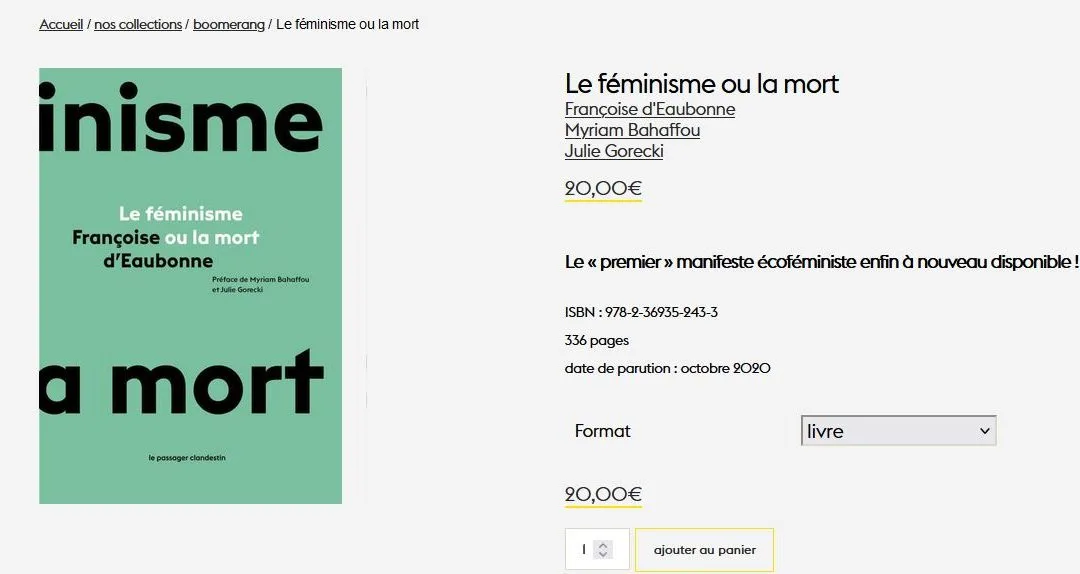
The English edition of Féminisme ou la Mort from Françoise contains a foreword by Carolyn Merchant, which I obviously read with great interest when I received the book.

Carolyn Merchant resituates the work in the history of feminism and ecofeminism. Going right back to the birth of patriarchy, she recalls its responsibility in creating the demographic problem (grow and multiply!) and gives the intellectual sources (Bachofen, Bebel, Engels, Briffault…) that made it possible to think about it.

She recalls a possible first use of the term “ecofeminism” in the USA in ’76, at Murray Bookchin’s Institute of Social Ecology in Vermont. This is followed by some key dates in the use of the concept (Inestra King, 1980, etc.) and the history of its exchanges with various currents led by Mary Griffin, Val Plumwood… up to the present day.

And she concludes that this thinking has its roots in Europe, in the early 70s, in the writings of Françoise d’Eaubonne:

All of these manifestations have their origins in the early 1970s mouvements in Europe on which d’Eaubonne drew and elaborated in her book Feminism or Death.

Philosopher and science historian Carolyn Merchant sheds light on the sources of ecofeminism. While this is obviously very useful scientifically, I see little point in discussing the subject outside this sphere.

Our struggle can very well do without a formal attribution of a prestigious title to this or that person, and Françoise’s immense talents will in no way be diminished. It doesn’t seem to me to be in the DNA of ecofeminism to build pedestals, if we consider that its project consists, among other things, in creating links and mutational collectives, beyond distinctions of gender, class, culture… and intellectual position.

…Qu’importe si chemin faisant vous allez m’abandonner comme une hypothèse…

Aragon, Épilogue

David Graebber tells us that he didn’t invent anything, any more than Marx or anyone else did. For him, the exercise of thought consists in capturing the debate of his time and restoring a situated synthesis that embraces as much of the living world as possible, giving our species an additional brick in the understanding of the world. So there’s no need to cry genius: our propensity to idolize doesn’t need that to give us masters to follow.

Finally, let’s not forget that this is a matter for the genz of the North. The South did not wait for our permission to wage ecofeminist battles long before the term was coined and conceptualized. To such an extent that, following contemporary anthropology, it is indeed in the immemorial roots of matriarchal societies that we must situate the origin, when it comes to finding one.
Women suffer most from the climate crisis

Women suffer most from the climate crisis

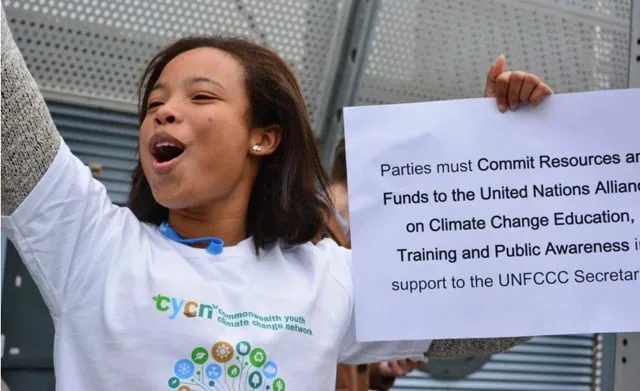
Madrid, December 2019. Climate activist Marie Kolo has come all the way from Madagascar to take part in the COP 25 World Climate Conference. A determined 31-year-old with her tongue firmly in her cheek, Marie Kolo had taken the liberty, a few days earlier, of criticizing Madagascar’s Minister of the Environment, Alexandre Georget, on Facebook. In front of the COP delegates, he came across her, grabbed her by the arm and insulted her. How could a young woman have the nerve to criticize a male member of the world’s powerful caste?

Madagascar. The average age of the island’s 28 million inhabitants is 19. However, young people’s voices, wishes and concerns are generally not heard or represented in parliaments and power structures. Marie Kolo insists on the place that should be given to young people and to women. An article in Der Tagesspiegel (a German daily distributed by subscription only) puts it this way:

She describes herself not only as a climate activist, but also as a gender advocate and ecofeminist, a term first coined in the 1970s and traced back to women’s rights activist Françoise d’Eaubonne, who died in 2005. For ecofeminists like d’Eaubonne and Kolo, ecocrisis and the oppression of women are linked. The exploitation of nature and the oppression of women are, in their view, the two faces of capitalism.

Marie insists on the link between the oppression of women and the exploitation of nature:

Many don’t even know that there is a link between gender and climate change. And when it does, it has little or no priority in the negotiations. Those who suffer most are women.

One of the many examples Marie Kolo highlights is the aftermath of the 2010 earthquake in Haiti: after the quake, women refugees in emergency camps were often physically and sexually abused. Another example:

In the patriarchal societies of the global South, women are responsible for many daily tasks. They look after the family’s food and water supplies, for example. To do this, women have to walk long distances in the arid regions of Madagascar – often ten, sometimes up to twenty kilometers. When they get home, they can’t drink the water, no matter how exhausted they are. First it’s the men’s turn, then the children’s, then the animals’. In the end, the women can drink, if they have anything left. The same applies to the food supply.

Marie Kolo says she was a rebel from the age of 8. It was a few years later, when a textile factory opened not far from her home and began “to change the color of the fields”, that Marie Kolo became an activist. Her petition against industrial air pollution was successful, and the factory was forced to close shortly afterwards. Women who inspire her: Wangari Maathai (“the woman who planted trees”, Kenyan, Nobel Peace Prize winner in 2004) and Vandana Shiva (Indian ecofeminist activist, head of the Research Foundation for Science, Technology and Natural Resources, alternative Nobel Prize winner in 1993).

At climate conferences, the majority of delegates are white, elderly men. (translated with DeepL)

The Meadows report is 50 years old

The Meadows report is 50 years old

The Earth’s circumference is 40,000 km, and all human ingenuity will never add a single metre more,” Françoise d’Eaubonne used to say. We live in a finite world. Yet Patriarchy and Capital blindly pursue infinite growth in production, exponential consumption and limitless demographics.

The Meadows Report is 50 years old. Limits to Growth (its real title) was written in 1972 at the request of the Club of Rome (a think-tank bringing together scientists, economists and national and international civil servants). Françoise had probably read it when she became aware of the ecological emergency in the early 1970s. On the occasion of its reissue (published a few days ago by Rue de l’échiquier), the online daily Reporterre published an interview on March 3 with emeritus researcher Dennis Meadows, one of the report’s authors.
*** Translated with www.DeepL.com/Translator (free version) ***

He created a worldwide sensation. It is often considered one of the monuments of political ecology. Yet the ideas of the ground-breaking 1972 report Limits to Growth, better known as the Meadows Report, have been little or never taken up by the world’s leaders. It demonstrated for the first time that the economy could not continue to grow indefinitely in a finite world.

50 years on, where do we stand? The 2022 report by the IPCC (Intergovernmental Panel on Climate Change) has just taken stock, focusing on the consequences of climate change and how societies can prepare for them. The msn portal interviewed one of its contributors, ecologist and geographer Wolfgang Cramer.

Today, there are concrete examples of adaptation to climate change everywhere. Among these, there are some interesting options that can be put forward. Agroecology is one of them. In many regions, this model of agricultural production (which relies as much as possible on the functionalities offered by natural ecosystems and seeks to reduce pressure on the environment as much as possible) is now seen as an important avenue for adaptation.
(Translated with www.Deep)

Carolyn Merchant : Feminism or Death

Feminism or death

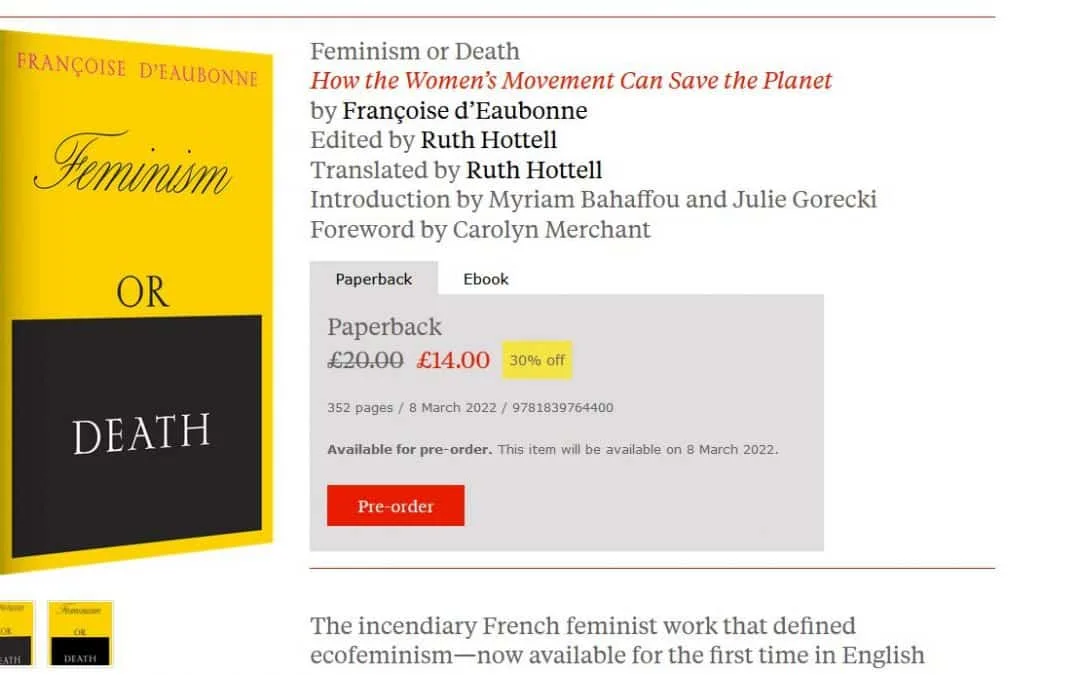
Released in the USA at the beginning of March 22, it is a translation of Le féminisme ou la mort by Ruth A. Hottell. The afterword is by Carolyn Merchant.

“The incendiary writing of the French feminist who defined ecofeminism – For the first time available in English” is the Verso Books tagline introducing the book.


Elle a argumenté le fait que l’objectif du féminisme n’était pas de résoudre une question d’égalité de droits, mais d’agir sur ce qui sépare la vie de la mort pour les humains et la planète…
Elle a été la première à proposer une politique écoféministe en affirmant que le féminisme et l’environnementalisme doivent faire advenir une “mutation”…

An update on publishing projects

An update on publishing projects

Le Féminisme ou la Mort has met with interest well beyond our borders. 3 translations are in progress:

    • in the United States, from Verso Books, in March 2022;
    • in Turkey, with Ithaki Publishing, by July 2023;
    • in Italy, with Prospero Editore, by July 2023.

In this newsletter on the contemporary resonance of Françoise’s thought, we regularly publish information on articles written abroad, when we see them, without claiming to be exhaustive. The interest shown by these publishers reinforces our conviction that her thought is spreading throughout the world…

By mid-2023, no fewer than eight new editions, reissues and translations are now assured, and you’ll be hearing about them here as they come out. And there’s more to come!

Thalie lends us a song

Thalie lends us a song

Singer Thalie, who knows and appreciates Françoise, lends us a song that she performs, with the kind permission of the copyright holders of its author, Michel Tonnerre, whom we also thank.

But what does a “sailor” song have to do with this site?

Françoise was very attached to her Breton and maritime roots. A direct ancestor, a marine carpenter in Saint-Malo, founded a prosperous business in the 1800s on the Île de France (Mauritius), which gave him the opportunity to refit ships, including Surcouf’s.

The theme of the sea, its privateers, its libertarian buccaneering, was close to Françoise’s heart, and is found again and again in her work. And, at her request, her ashes were scattered off the Gulf of Morbihan, carried by an emblematic Nantes sailboat, Le Naoned, an 11 m 50 Marconi sloop.

In 1959, Françoise published Le Gabier de Surcouf. We don’t have it, so this was an opportunity for us to include this beautiful song in the notice. There aren’t many female singers in this repertoire, and getting behind the singer-songwriter, Michel Tonnerre, is anything but easy. Thalie pulls it off brilliantly, and in my opinion, she has done the best cover of the song. And I’m convinced that Françoise would have loved it. Questions of breath, images, roots, interpretation… (Vincent)
*** Translated with www.DeepL.com/Translator (free version) ***