Edition in Turkey

Edition in Turkey

Caroline Goldblum’s book “Françoise d’Eaubonne and Ecofeminism” is now available in Turkish. Translated by Can Berk Işık. Publisher: @yeniinsanyayinevi

Publisher’s presentation:

A lprolific writer, seasoned activist, pioneer of the feminist movement and degrowth, Françoise d’Eaubonne (1920-2005) is the originator of the concept of ecofeminism. The patriarchal oppression of women and the capitalist exploitation of the planet would stem from the same mechanisms of domination and must therefore be fought together.

Misunderstood or even ridiculed in France, her project to mutate towards a self-managed society, based on gender equality, equality of peoples, and preservation of nature, largely echoes the ideals of degrowth.

Caroline Goldblum shows us the relevance and timeliness of ecofeminist ideas and modes of action in a context of climate emergency.

Françoise, on t-shirts?

Françoise, on t-shirts?

What can we see in this photo taken in Spain?

On the left, a young female Frente Amplio MP, Bettiana Diàz, poses with a T-shirt bearing the logo Feminism or Death. This sparked off a controversy: according to a tweet from the newspaper El Pais, she was reproached for having “as a legislator…used the colors of a national symbol for the feminist cause”.

Françoise’s relationship with her landmark book: coincidence or not?

As the photo dates from March 2023, it’s possible that it’s a coincidence, but not certain. For Yayo Herrero, a well-known figure in Hispanic ecofeminism, no doubt already knowing that she would preface the translation of Feminism or Death (to be released in Spain in June 24), was able to speak publicly about the book. In any case, she doesn’t fail to mention Françoise, whom she considers essential, as she told me in an e-mail.

In any case, Françoise has been very well received in Spain, by civil society and certain political parties. And at university: our friend Delphine Sangu made a big splash with her speech at the Alicante Congress (a landmark event in the life of ideas in Spain), and returned with new invitations and requests to collaborate on this historic figure.

This bodes well for the book’s distribution! (Translated with www.DeepL)

Feminist art factories

Feminist art factories

(Photography : Jean-Claude Aubry)

Perspective, a biannual devoted to art history news, has published its issue for the first half of 2024. Entitled “Autonomy”, the issue examines “autonomy in art, based on key moments such as the rise of aesthetic philosophy in the 18th century, or modernist formalism and the avant-gardes of the last century. (…) Historians of art and architecture, anthropologists, philosophers and artists will examine the myth and prehistory of this concept through the links between art history and the human sciences, the relationship of art, works of art and artists to the social and moral fields and to political struggles, or by approaching works and images as vectors of emancipation or motors of autonomy.

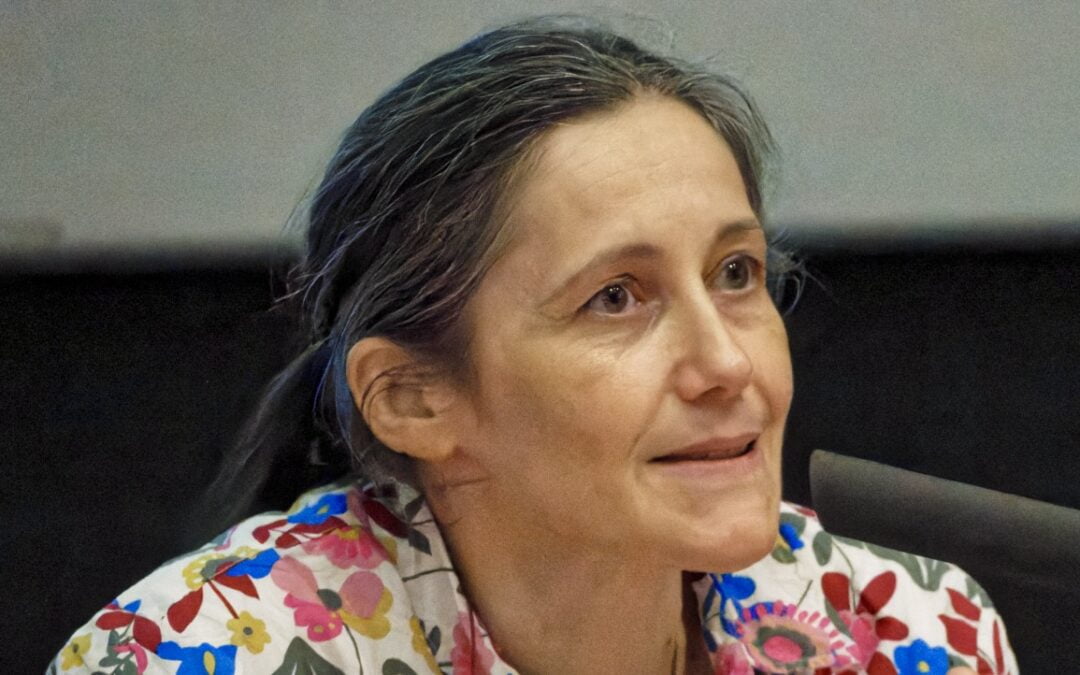
Among the many contributions, let’s highlight the fascinating conversation between Béatrice Josse and Fabienne Dumont on the theme of “Feminist fabrications of art and art history: a ‘paradoxical radicality’?” Béatrice Josse founded the Fonds régional d’art contemporain de Lorraine and is deeply committed to women artists. Our friend Fabienne Dumont (photo above), art historian and critic, is a specialist in feminist, gender, queer and masculinist issues in contemporary art in France and abroad.

This dialogue emphasizes the “essential work of art historians and so-called feminist critics, who read, reread, research and discover works that have been invisibilized by mainstream history” (Béatrice Josse), and illustrates it with numerous examples of resistance to “the place assigned to women and the world that men were constructing for them and their children. At the same time, women artists began to regain possession of their representations” (Fabienne Dumont).

Fabienne Dumont is currently working on a new edition for Presses du réel of Histoire de l’art et lutte des sexes, a 1978 book by Françoise Hadjinicolaou, who attacked “the lack of feminist vision in Nicos Hadjinicolaou’s Marxist thought” in Histoire de l’art et lutte des classes.Translated with DeepL.com (free version)

A thesis on “L’Indicateur du réseau”, de Françoise

A thesis on “L’Indicateur du réseau”, de Françoise

(photography : École des Chartes)

On Monday June 3, Lucie Guillemer defended her thesis, Édition de l’Indicateur du réseau (1977-1980), topographic “Contre-mémoires” by Françoise d’Eaubonne, at the École des Chartes, which “trains students in the analysis and conservation of historical sources, the auxiliary sciences of history and the exploitation of data through digital technologies(website).

Lucie, going back over Françoise’s biography and her struggles, drawing in particular on Isabelle Cambourakis’s excellent work published as an introduction to Contre-Violence ou la Résistance à l’État, proposes an “Eaubonnienne geography” to analyze l’Indicateur du réseau, this distinctive autobiography written not chronologically but geographically, by station.

By tracing the editorial history of this text, part of which has never yet been published, Lucie offers keys to understanding Françoise’s choice of this particular memorial form (for example, the potential influence of Malraux’s antémémoires on the form), and argues that it demonstrates authenticity rather than historical truth (her relationship to history being as personal as her relationship to geography).

The subject of my thesis obviously interested the teachers present, and I heard some interesting reflections on d’Eaubonne, so much so that I asked the author if they could be the subject of an article.

Following on from this thesis, the École des Chartes has expressed the wish that L’Indicateur du réseau be republished in its entirety, with Lucie Guillemer’s critically-acclaimed apparatus.

To be continued. In the meantime, you can find Lucie’s thesis position here.

Paris: the future “garden street” Françoise d’Eaubonne

Paris: the future “garden street” Françoise d’Eaubonne

Work on the future “Françoise d’Eaubonne” alley in Paris’s 14th arrondissement is almost complete, and the alley is now open to the public (as you’ll see in the photos below). In the near future, benches will be installed under each lamppost. A sign announces “the first garden street in the 14th arrondissement”. The inauguration should take place in September, in the presence of Françoise’s daughter and son (Indiana and Vincent), her grandson (David) and myself.

We’ll keep you informed of the date as soon as we know it.

Photo credit: Alain Lezongar (Translated with DeepL)

“Le sexocide des sorcières” translated into Italian

“Le sexocide des sorcières” translated into Italian

Milan’s Prospero Editore is publishing a translation of Françoise’s book, originally published in 1998 and reissued by Le Diable Vauvert in 2023 in Élise Thiébaut’s Sorcières collection.

The witch-hunt was not just a French phenomenon. Although it was less massive in Italy, the country was not spared from the misogynist plague: Triora and Benevent, the Sciliar massif, Rifreddo near Cuneo and the Valcamonica, among others, still remember the passage of the Inquisition. Commemorative steles, and even memorial ceremonies, are still held there today in remembrance of this dark historical episode.

The translation was provided by Sara Marchesi. She has already translated Le Féminisme ou la Mort under the title Il feminismo o la morte, the work in which Françoise first posited and conceptualized the term “ecofeminism”.

And this Thursday, April 20, we’ll be celebrating the book’s release in Milan, by watching Manon Aubel’s film with Italian subtitles, thanks to the Yume Dojo team who are hosting us for the occasion.

By opportunity, because this pretty place is available and 5 minutes from the publishing house? Certainly not.

The Yume Dojo, like other dojos in Europe, is part of the Itsuo Tsuda School which, in terms of its operation and philosophy, has little to do with what we know, or think we know, about contemporary “martial arts”, but much more to do with Françoise. It’s no coincidence that women are very much in evidence, even in the majority. Nor that one of its columns, aikidoka Manon Soavi, author of Le Maître anarchiste Itsuo Tsuda, is so passionate about Françoise that she keeps her alive on social networks.

A great time ahead, then, before the translation in June of Les femmes avant le patriarcat by Nova Delphi in Rome.