The traces
Audios
The Orator
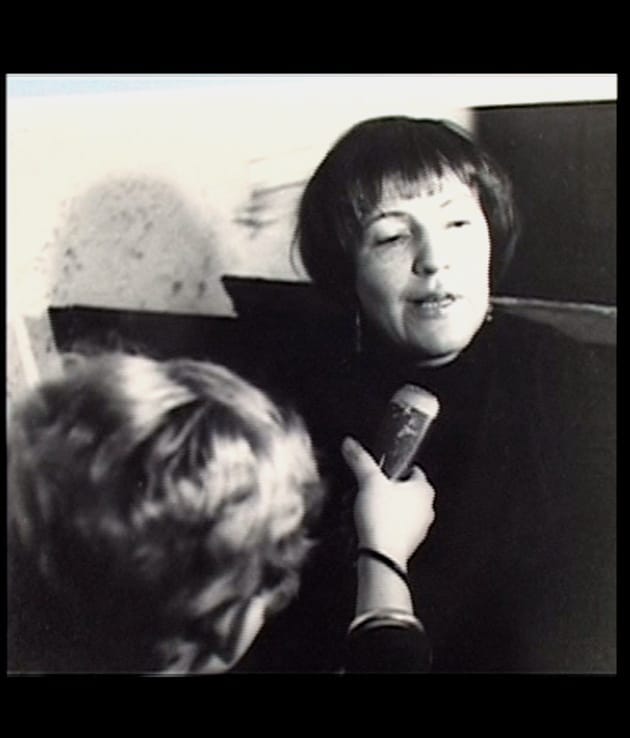
With her stentorian voice and sharp wit, the formidable Françoise was no stranger to verbal sparring in the courtroom or on set, as the INA archives attest. The audio recordings posted here are virtually unknown. In French. If you have some in English, let me know !
1999 : Autour du sexocide des sorcières

Françoise is 80 years old. Interviewed in a café in Saint-Denis (Paris) about *Le Sexocide des sorcières*, she discusses the Abrahamic religions and, more broadly, misogyny, patriarchy, and the gynophobia of the *Mannerbund*. She paints a brief portrait of herself, talks about her work as a writer, and shares a few childhood memories.
1972 : Détruire le pouvoir !

In 1972, the French television program Aujourd’hui Madame featured Françoise d’Eaubonne. Faced with an opponent who doesn’t understand why the feminist activist doesn’t want women to take power in place of men, Françoise replies succinctly:
– All power is bad in anyone’s hands.
– Why take it, then?
– To destroy it!


Une descente à Tours
Jean Royer, a national French politician and mayor of [city], was at the time the symbol of rigid Catholic morality and, as a result, homophobia.
Les Réunions à l’Odéon
Well, my mom (who’s a saint, since she’s My Mom) hadn’t bragged to me about that one. I should mention that at the time of that feat, I was only 12 to 15 years old—that explains it. (Vincent)
La Chanson du FHAR
To the tune of La Mauvaise Réputation by Georges Brassens.
Il est né le mouv’ment du FHAR…
Inspiring! Parents will generally avoid singing this Christmas carol in front of the nativity scene while their little ones are present.
Marie, Myriam, Meriem

A work by Françoise—very well done in terms of both the text and the performance—that brings to mind her novel *I Wasn’t Born to Die*. It would still deserve a different musical accompaniment, though 🙂
Les Stances

A song by Christiane Rochefort, written for the French Women’s Liberation Movement.
A Federico Garcia Lorca

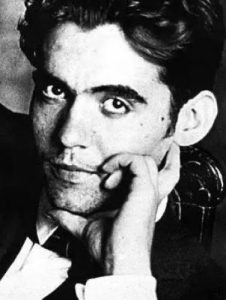
On August 19, 1936, the great Spanish poet Federico García Lorca was murdered in a field near Granada by fascist militiamen, who were acting in their usual manner. It is said that he was shot, but the controversy over the circumstances of his execution continues to this day.
Sur le pont de Morlaix

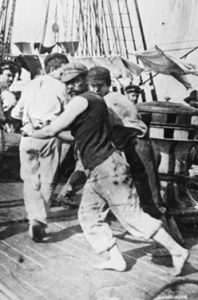
A hoisting song. This type of work song served very specific purposes: coordinating collective efforts during maneuvers—such as raising an anchor (hauling it in with the windlass) or hoisting or furling a sail. They also boosted the morale of the crew, who performed a difficult and dangerous job, and served as a collective memory. A good singer, like a good cook, made it easier to recruit the best sailors in places where enlistment wasn’t (too) forced…
Les 3 Marins de Groix

A rowing song. This story of the ship’s boy falling overboard has historical roots—the ship actually existed, and the event really happened. And the song has endured. As we’ve noted elsewhere, Françoise was deeply attached to her native Brittany.
In the 16th century, the Piston branch of the family was settled in Saint-Servan (Saint-Malo). They were shipwrights and shipbuilders who did business with Surcouf, maintaining his vessels.
Le Pendu de Saint-Germain

A song by Henri Heugel, circa the late 19th century.
La Chaisière de Saint-Sulpice

Is it a song by Françoise, or perhaps an old, realistic song that we haven’t been able to track down?…
Le Fiacre

A song from Françoise’s childhood. In the 1920s and 1930s, cars were far less common than horse-drawn carriages. But they would never become as widespread as those.
Requiem pour un pédé
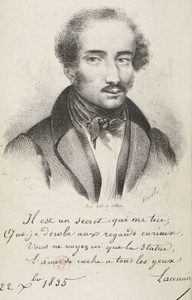
A poem by Lacenaire from the early 19th century—that is, between 1820 and 1836, before he was guillotined.
De Lacenaire

A poem by Lacenaire from the early 19th century—that is, between 1820 and 1836, before he was guillotined.
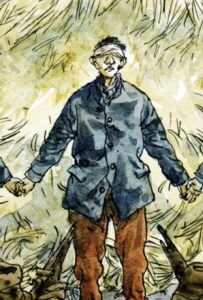
Les 3 Cigarettes

In the same vein as *Soir de bataille*, this short poem tells the story of a young boy who is about to be shot—probably for lacking the zeal to slaughter the enemy, or for leaving the trench only to be mowed down by machine-gun fire…
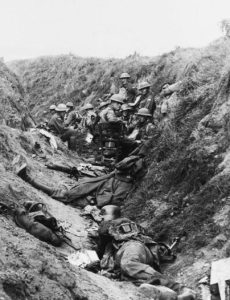
Soir de bataille

Poems written in the slang of the trenches in 1914. It’s a safe bet that he got this from his father, who found himself caught up in that bloodbath and returned from the front in 1916 with his lungs ravaged by poison gas.
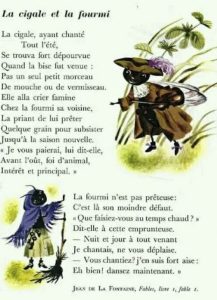
La Cigale et la Fourmi

Perhaps the most famous of all French poems—one that has been the delight (or the terror!) of many generations of elementary school students—Françoise offers us a 20th-century slang version following a classic French translation.