Le Fiacre
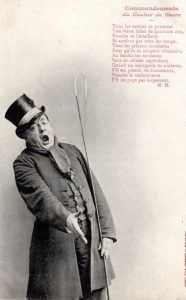
A song from Françoise’s childhood. In the 1920s and 1930s, cars were far less common than horse-drawn carriages. But they would never become as widespread as those.

A song from Françoise’s childhood. In the 1920s and 1930s, cars were far less common than horse-drawn carriages. But they would never become as widespread as those.
 ParThe Editorial Team
Le
Paris, Les Editions du Sud, 345 pages This biographical novel begins with a 3-page introduction, Le 19ème siècle et le triomphe de la bourgeoisie, which ends as follows: “Certainly, from 1830 to the first decades of our 20th century, this was the golden age of the bourgeoisie, with that unpleasant nightmare of the Commune, a…
ParThe Editorial Team
Le Paris, Calmann-Lévy, 1962, 158 pages. Françoise saw in Flaubert the first of the bourgeois writers (with time and money) to have introduced what she considers to be the cardinal value of his class in literature:: investment in time (time is money). If she doesn’t forget his misogyny and the atrocious pages he wrote against the…
ParThe Editorial Team
Le Paris, Libre Arbitre, 116 pages. Preface by Gilles Perrault. A Protestant Baptist, Pastor Doucé founded the Center of Christ Liberator (CCL) in Paris in 1976, a space for welcoming and speaking out for believers in sexual and gender minorities. After the mysterious disappearance of the pastor in July 1990, Françoise participated with Gilles Perrault in…
ParThe Editorial Team
Le In 1980, issue 20 of Sorcières, les femmes vivents published 6 pages by Françoise. She summarizes her long work to flush out the root causes of our aberrations. The passage of time only strengthens her pen and, despite anthropological reminders that can sometimes be dated, she gets to the point in the last two dazzling…
ParThe Editorial Team
Le felina editrice, 1976, 246 pages In this Italian version of Les Femmes avant le patriarcat, a note on the first page reads: “questo libro e diretto solo alle donne” (this book is for women only). By creating ecofeminism, Françoise’s genius was not to bring a new concept: it was to connect us with an immemorial…
ParThe Editorial Team
Le Paris, Encre, 235 pages. Note: Awaiting annotation.