1958: Chevrette et Virginie

Hachette, coll. Bibliothèque verte n°46, 253 pages.

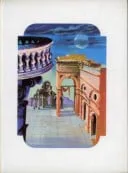
This first novel intended for young people is adorned with a cover whose reading could be much less innocent today than at the time. And it is the story of two adventurous and shipwrecked women that is told to us. We can even venture to think that Françoise would have done well without the character of the Chevalier de La Barre, who seems to be there to save appearances and preserve the moral purity of our dear darlings… But wouldn’t this be an anachronism or speculation on possible intentions still unconscious in the author? (Vincent)
i

1957: Les Amours de Roméo et Juliette

Paris, Édition Rombaldi, coll. Le club de la Femme.

Here, a novel with Cyranesque accents, which is worth it for its detailed and colorful descriptions of Verona in the 15th century. Apart from that, it’s a book to support herself financially, written without passion. Living from her pen, without financial support, position or husband, may have required her to produce this work. (Vincent)

i

1957: Belle humeur ou la véridique histoire de Mandrin

Paris, Le livre contemporain – Amiot-Dumond, coll. Visages de l’aventure, 202 pages.
The Ferme Générale (1680 – 1794) was a body of financiers and shareholders who, having bought the office from the King, collected the various taxes in force, with the right to keep half of them. Needless to say, the Farmers were overzealous, and infinite abuses were committed: here we have the ancestor of the international mafias and trusts, depending on which side of the law they are on.

It was against this system and its men that the highwayman Mandrin, France’s Robin-des-bois, rose to fame, ending up roasted alive in a public square in Valence in the early 1750’s. He remained in popular memory for a long time, and there are still recordings of songs celebrating his exploits.

A character, then, befitting the picaresque pen of a Françoise in her thirties, who quenches her thirst for justice and a taste for the epic in the writing of her story.

i

1956 : La Vie passionnée d’Arthur Rimbaud

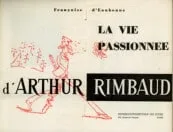
In this book, Françoise shows not only the poet, but above all the man Rimbaud in all the ups and downs of his life, with his vices, his eruptions of character. Rimbaud’s genius shines through, with his eruptive temperament, his absolute loyalty to himself, his mockery of all bourgeois morality, and his transformation from poet to pure merchant, interested only in making money in Abyssinia as an arms dealer.

i

1955 : Jours de chaleurs

Paris, Éditions de Paris, coll. série blonde, 249 pages.
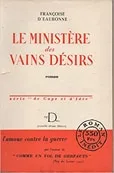
Spain again. This sentimental novel hides under an apparent lightness memories of Françoise’s youth: the war in Spain, the Campaign in France. The novel’s heroine hides a secret, and a fiery soul not unlike that of the author. The secondary characters are probably drawn from a series of encounters made at the villa Les Pamplemousses of her Toulouse childhood after the retirada, the exodus of Spanish republicans in 1939. (Vincent)

i